
| Program or measure | IBM's reported figure | What it supports | What it does not prove |
|---|---|---|---|
| Time saved in 2024 | 3.9 million hours | IBM estimated time released through its AI and automation work in 2024. | A universal conversion from hours saved to cash savings. |
| End-of-2025 ambition | USD 4.5 billion savings target | IBM said it was on track to reach that savings figure by the end of 2025. | That the target was produced by digital workers alone. |
| Client Zero outcome | USD 4.5 billion productivity gains over three years | IBM's later case study presents the figure as the result of AI, hybrid cloud, automation, partner technology and consulting expertise together. | A clean causal result for any single product, model or workflow. |
| Scale of designed use cases | More than 155 | The case study says IBM designed more than 155 AI use cases for core functions. | That every designed use case was deployed, equally valuable or directly comparable. |
Workflow design
What IBM's $4.5 billion AI transformation says about redesigning work
IBM's Client Zero program is a useful case because its reported gains came from redesigning work across process, data, automation, AI and operating ownership—not from treating model selection as the transformation.
- Workflow design
- Implementation
- Managed operations
IBM's reported USD 4.5 billion in productivity gains is easy to turn into a technology headline. The more useful reading is operational: IBM did not describe its internal transformation as a contest to pick the best model. It described a program to remove unnecessary complexity, simplify end-to-end work, and then use automation and AI where they could change the work itself.
IBM's Client Zero story is not a promise that every organization can reproduce a headline number.
The answer is in the order of operations
In IBM's account of the program, the three guiding principles are to eliminate operational complexity, simplify and accelerate end-to-end workflows, and then automate manual tasks and embed AI. That is a stronger discipline than starting with a tool demonstration and looking for a task to attach to it.
Eliminating complexity asks whether a report, approval, reconciliation or handoff needs to exist at all. Simplifying a workflow asks whether its inputs, systems, decisions and handoffs work together. Only then does task automation become a sensible design choice. Automating a bad handoff can make the wrong work happen more quickly; a workflow is improved when the team can state its trigger, required context, allowed actions, escalation points, expected output and owner.
What the reported numbers do—and do not—say
IBM has reported related figures in different contexts. They should not be collapsed into a claim that one class of AI worker generated all of the value.
The Client Zero case study is particularly clear about the combined nature of the program. It attributes the reported productivity gains to AI and other technologies, including hybrid cloud and automation, as well as partner technology and consulting expertise. That is a helpful caution for leaders evaluating AI projects: results often come from changing the surrounding system, not from a model in isolation.
IBM's 4Q25 prepared remarks use another precise description: USD 4.5 billion in annual run-rate savings exiting 2025. That is not interchangeable with a one-time saving, a three-year cumulative measure or a return from a single automation.
The work worth mapping before selecting technology
For a business or operations leader, the useful unit of analysis is rarely “an AI use case.” It is a bounded piece of work with a real owner and a visible standard.
Start by mapping the work as it happens now:
- Name the trigger. What event begins the workflow: a customer request, a completed meeting, an exception, a monthly close step or a system alert?
- Trace the path. Which people, systems, documents and decisions are involved from trigger to completed result? Where does someone wait, re-enter data or reconcile context?
- Separate necessary judgment from procedural friction. Some human involvement is a policy or quality requirement. Some exists only because information is scattered or a handoff is poorly defined.
- State the output and standard. What should be created, updated, routed or decided? How will someone know it is complete, accurate and safe enough to proceed?
This map can reveal that the best intervention is a system change, a cleaner intake, a standardized decision rule or a better data source—not an agent. It can also reveal a narrower AI role: prepare a draft, assemble a packet, identify missing information, classify a request or route a decision.
Simplify the workflow before expanding the automation
IBM's emphasis on end-to-end workflow simplification is an important counterweight to local optimization. A team might use AI to write a better handoff note, for example, while the next team still must search three systems, request missing details and decide who owns the case. The note is better; the workflow is still fragmented.
Instead, ask which changes make the whole path shorter and more legible. That may mean establishing a source of trusted data, reducing the number of intake forms, removing a duplicate approval, standardizing a status vocabulary or deciding that one system is the record of action. These are unglamorous changes, but they are often the conditions that make an AI capability dependable.
This workflow-first diagnosis is also how Worktree approaches AI automation services: simplify and bound the work before selecting technology.
Select bounded workflows, then define control and ownership
Once a workflow is understood, select a first scope that is narrow enough to evaluate and important enough to matter. Good candidates tend to be recurring, have identifiable inputs, involve a known decision path and produce an output someone can review. They do not need to be trivial; they do need to have boundaries.
For each selected workflow, define five things before expanding it:
- Access: which records and tools are required, and which are not?
- Authority: what may the system do directly, what may it prepare, and what must remain approval-gated?
- Exceptions: what should stop the workflow, who receives the exception, and what context do they need?
- Evidence: what record shows the sources used, actions taken, output produced and final status?
- Ownership: who is accountable for the business rule, the technical behavior, the data dependency and the ongoing review?
Those controls should not be added after a workflow has been released. They are part of the workflow specification. A useful AI routine is not just an answer generator; it is a bounded participant in a process with permissions, handoffs and review.
When a candidate is ready, Worktree's AI implementation services carry it through integration, controls, evaluation and launch.
Measure the operating result, not just model activity
IBM's framing of speed, measurement and sponsorship offers a useful measurement discipline. The metric should reflect the business result the workflow is meant to change: cycle time, resolution quality, rework, cost of delay, exception rate, customer outcome or employee effort. A count of model calls, prompts or agent sessions may help operate the technology, but it does not establish value.
Measure before and after, and keep the comparison honest. If an intervention reduces a task from ten minutes to two but creates a new review queue, the saved time is not the whole result. If it increases throughput but sends more exceptions downstream, the cost may have moved rather than disappeared. If an apparently successful workflow depends on one unusually careful operator, it has not yet become a reliable operating capability.
The useful loop is: make a bounded change, observe representative cases, review failures and edge cases, update the workflow or controls, and decide whether to expand.
What not to infer from IBM's example
IBM's transformation should not be read as a universal ROI forecast, a recipe with identical inputs, or proof that digital workers alone produce enterprise-scale savings. IBM's own materials describe a multi-year program combining AI, automation, hybrid cloud, data foundations, partner technology, consulting expertise, cultural change and executive sponsorship.
It also should not be read as an argument to automate every manual step. IBM's first principle is to challenge whether the work needs to be done. In many organizations, the highest-value result of an AI assessment may be a simpler process, a removed handoff or a better-defined human decision.
The transferable lesson is modest but demanding: treat AI as a way to redesign and operate work. Start with the workflow, make its boundaries and owners explicit, use technology where it changes the result, and measure what happens after the system meets real operating conditions.
Method note
This article uses IBM's own published materials and keeps related figures in their stated contexts rather than combining targets, annual run-rate savings and multi-year productivity gains into one claim. The IBM transformation article supports the three-principle framework, two-week sprint approach and 2024 hours-saved estimate. The Client Zero case study supports the three-year productivity-gains framing, more-than-155-use-case figure and combined-program description. IBM's 4Q25 prepared remarks support the annual-run-rate characterization exiting 2025.
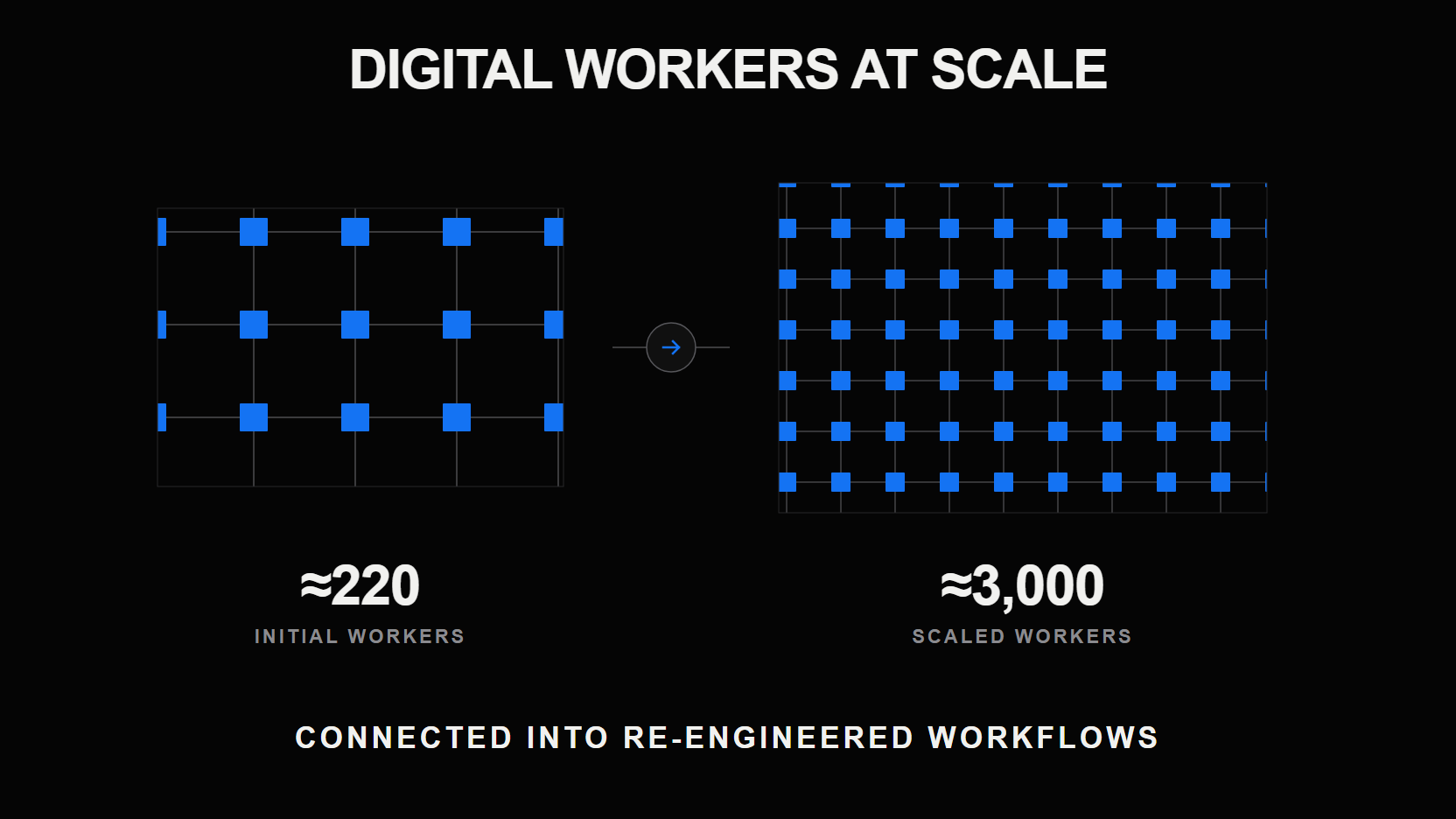
This article deliberately does not use a digital-worker count as evidence of value. Implementation counts can be useful context, but they are not a substitute for a defined workflow, attributable outcome or measured operating result.